Showing posts with label Co-operatives. Show all posts
Showing posts with label Co-operatives. Show all posts
Friday, April 13, 2018

Tuesday, January 26, 2016
February's Discussion Meeting
DRONFIELD LABOUR PARTY DISCUSSION MEETING
TOPIC : THE "FAIR CARE" CAMPAIGN
SPEAKER : CHERYL BARROTT
TIME ; 8pm to 9.15pm
DATE : SUNDAY, 14th February

VENUE : CONTACT CLUB, SNAPE HILL LANE, DRONFIELD, S18 2GT
Cheryl is a member of the Co-operative Party and has played a major role in forming and now running the "Fair Care" Campaign. The Campaign describes it role in the following way -
"Our care system is broken, at the moment a few large-scale companies, who act as the middle-man in the care system, are profiting from human misery. Both the person providing the care and the person receiving it are losing-out. Why should the middle-man profit from providing mind-numbing care for service users and poverty for staff? There is a better way, a co-operative way."
For fuller details link here.
Monday, January 14, 2013
The ILP At Dronfield
ILP@120: Lessons from History
Jan 14th, 2013 | By willb | Category: Articles, Frontpage, News
WILL BROWN reports from the Dronfield Labour
Discussion Group where more than 30 activists braved a wintery night to
mark the ILP’s 120th birthday on Sunday 13 January.
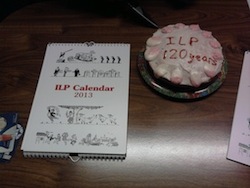
Fuelled by a special surprise birthday cake made by Christine and Rosie Smith (pictured left), the audience heard the ILP NAC’s Barry Winter assess the contemporary lessons to be learned from the ILP’s history.
Barry began by reminding the audience just what a huge task the founders of the ILP faced. Hostility from the trade unions, from the Liberals and from much of the working class, meant that founding a party for labour – ‘a party that will’ – was a project that had to be argued for and fought for.
Even the later creation of the Labour Party necessitated compromises that many were unhappy with as the ILP’s commitment to socialism was tempered by the reformism and electoral priorities of others. Looking to achieve what is best under the constraints of the day, while never giving up on the longer-term aims we seek to achieve, has often been a hallmark of the ILP’s politics, Barry noted.
Looking to the present day, Barry focused on the interconnections between the necessary role of social democratic electoral parties, left groups like the ILP, and wider movements for change. While parties inevitably become focussed on short-term manoeuvring between tight electoral constraints, social movements can be more open and creative, he said. Although often short-lived, at their best movements create political space that social democratic parties can occupy.
In its history the ILP has played both roles, creating space and changing political landscapes while also engaging in electoral politics. Finding new ways for dialogue and cooperation between these two areas of political activity remains one of the most important challenges we face.
—-
Many thanks to Christine and Rosie Smith for the cake and the photo.
More articles on the ILP’s 120th anniversary can be found here.
More on the ILP’s history is here.
Buy ILP 120th anniversary calendars here.
Fuelled by a special surprise birthday cake made by Christine and Rosie Smith (pictured left), the audience heard the ILP NAC’s Barry Winter assess the contemporary lessons to be learned from the ILP’s history.
Barry began by reminding the audience just what a huge task the founders of the ILP faced. Hostility from the trade unions, from the Liberals and from much of the working class, meant that founding a party for labour – ‘a party that will’ – was a project that had to be argued for and fought for.
Even the later creation of the Labour Party necessitated compromises that many were unhappy with as the ILP’s commitment to socialism was tempered by the reformism and electoral priorities of others. Looking to achieve what is best under the constraints of the day, while never giving up on the longer-term aims we seek to achieve, has often been a hallmark of the ILP’s politics, Barry noted.
Looking to the present day, Barry focused on the interconnections between the necessary role of social democratic electoral parties, left groups like the ILP, and wider movements for change. While parties inevitably become focussed on short-term manoeuvring between tight electoral constraints, social movements can be more open and creative, he said. Although often short-lived, at their best movements create political space that social democratic parties can occupy.
In its history the ILP has played both roles, creating space and changing political landscapes while also engaging in electoral politics. Finding new ways for dialogue and cooperation between these two areas of political activity remains one of the most important challenges we face.
—-
Many thanks to Christine and Rosie Smith for the cake and the photo.
More articles on the ILP’s 120th anniversary can be found here.
More on the ILP’s history is here.
Buy ILP 120th anniversary calendars here.
Tuesday, April 3, 2012
Lack of Employee Representation
Details are provided here about employee representation on boards in sixteen European nations. The UK is not only bottom of the list alphabetically.
Hat Tip : Jon Williams.
Hat Tip : Jon Williams.
Tuesday, January 24, 2012
"There Is An Alternative To Capitalism" by Steve Thompson

2012
United Nations
International Year of Co-operatives
There is an alternative to Capitalism
2012 will be a year of opportunity to demonstrate that alternative. Privatisation of resources, businesses and services, benefit the privileged few and reduce everything to the building of private empires of wealth and political power. Everyone else being pawns in the games of the private profiteers. Life is too precious for that.
The Co-operative Commonwealth
I do not claim to reveal a panacea in this subject of how we can all live together to create a social and physical environment which is conducive to health and wellbeing. It would be foolish to do so. But I can reflect upon the great work (with both its successes and failures) of the Co-operative Movement.
It had its origins in the time when people were being forced by poverty to move from the countryside to the towns to seek work in manufacturing and mining. These people were taken advantage of by the privateers of their day, the owners of the factories and the mines.
It was at this time that people were forced to seek an alternative for their very survival. The collectivist approach stirred in the minds of men. People clubbed together and formed co-operatives, and were sometimes inspired by benign and learned men like Dr. William King of Brighton. This was the beginning of a precarious and often unsuccessful Co-operative Movement. The organisation was patchy and insecure, but this nascent movement organised a number of Congresses.
The co-operative movement at this time was not cohesive, it was not until the Rochdale Equitable Pioneers Co-operative Society was formed that the Co-operative Movement began to make some headway. An experienced co-operator who chaired the Rochdale Board, Charles Howarth, had evangelical zeal and was practical. Experience had taught him what worked and what did not work, he had been involved in a previous co-operative in Rochdale which had failed.
With the success of the Rochdale Equitable Pioneers Society, Charles Howarth and other members were being asked to help other communities to set up co-operatives. And these new co-operatives were teaching others still, so that co-operative societies were springing up everywhere and had the benefit of guidance which meant that they were less likely to make the mistakes that earlier co-op’s had made.
It is this sense of solidarity, mutual support and co-operation between all these disparate enterprises which make the Movement what it is.
But values and principles which the whole Movement could agree to were needed to unify the Movement. Co-operation cannot work in isolation.
The Rochdale Equitable Pioneers Society formed in 1844 established principles for the Movement.
The Values & Principles of the International Movement in the 21st century are adapted for the modern world and agreed by all bona fide co-operatives, but they have their origins in the Principles first established in Rochdale.
The Rochdale Principles
1). Open membership
2). Democratic control (one man one vote)
3). Distribution of surplus in proportion to trade
4). Payment of limited interest on capital
5). Political and religious neutrality
6). Cash trading
7). Promotion of education
Experience and practicality over the ensuing years necessitated some changes.
For example, political neutrality is impossible when the Conservative Party exists to support the very anathema of co-operation, i.e. the private sector driven by personal aggrandisement and competition – the individualist philosophy. The Movement needed a political party which would be an advocate of co-operation, in due course
The Co-operative Party was born, and found an ally in the Labour Party.
Cash trading is no longer numbered amongst the Co-operative Principles.
A constant and very central principle for the Co-operative movement is the promotion of education. The early co-operatives had reading rooms before the advent of the public library. Lectures and classes were organised for the members. Many working class people in areas of depravation owe much to the co-operative movement for their educational development. Moreover, an educated membership was necessary for the continuance and development of the co-operative, after all, co-operatives are member run and member owned for the benefit of the members and the wider co-operative commonwealth. The directors and activists of the co-operative society are elected from the membership by the members. An aware and educated membership has always been very important, it is indeed the very foundation of the co-operative movement.
The dream of The Co-operative Commonwealth is the common ownership and control of the engines of society for the collective wellbeing of all people and a sustainable environment. This vision is so different from the world as it is, although the Co-operative movement has been making steady progress for two centuries, steady progress with setbacks from time to time. But the world is still Capitalist, there is a long way to go.
The Co-operative Group
The Co-op or as its businesses are now branded ‘The Co-operative’ is, of course,a co-operative. This means that it is guided by the Values and Principles of the Movement.
In capitalism, profits go to speculators who buy and sell shares on the stock market. The profits, in other words, go into private individuals pockets. The businesses are answerable only to a moneyed elite, their only purpose, profit maximisation.
The Co-operative is completely different.
Any surplus which the Co-operative makes is directed into fulfilling the purposes of the Co-operative Movement, guided by its Values and Principles and steered through a representative democracy, every member can play a part.
A percentage of the surplus is returned to the members, staff and communities in dividend or share of the profits as it is known.
Questions to ask when you trade with a business:
What is the purpose of this business?
For who’s benefit is this business operating?
If it is not a co-operative the answer to these questions will be; for private wealth accumulation.
A co-operative is a business which has intrinsic value, trades fairly and employs trading surplus to further the objective of collective wellbeing.
See here.
Steve Thompson
Sunday, October 16, 2011
Jon Williams Reports on "Open Day" at the Labour Party Conference
 Question Time at the Labour Party Conference
Wed 28th Sep Labour Party Conference “Open Day” by Jon Williams
As part of Labour’s New Politics, Fresh Ideas to encourage a wider participation in politics Wed 28th Sep was open to specifically non Labour members by invitation; it also allowed Labour members to apply. Activities at Conference were Exhibition stands, Policy Workshops and Seminars plus the access to the Main Hall at 5pm to take part in Question & Answer session hosted by Labour’s leader Ed Miliband. I attended the following events and made a few notes on the discussions below,
Policy Workshop in the Open Zone in the Exhibition Hall: Helping the next generation do better than the last
This was an open forum with 3-4 MPs answering questions from open day attendees. Some of the topics / questions asked by the audience were,
Tax avoidance – more inspectors should be employed to recoup lost tax
Families on low income – how will they cope?
Poverty is on the increase under the Tories
University costs – 30 years to clear £50k worth of student loans
There was concern about the removal of BSF (Building for Schools Fund)
Legal Aid cuts – how this will impact on local authorities to provide an alternative when pressure is to make cuts
Youth employment – NEETS (Not in Education, Employment or Training)
Increase in retirement age will take away a source of child care
Removal of pension tax relief for high earners was sought
Change procurement rules to support UK industry when bidding for European work e.g. Bombardier and include a requirement for companies to run apprenticeships before they can apply for public sector contracts
Support for small business now RDA’s have been scrapped, will LEPs (Local Enterprise Partnership) provide similar support? http://www.bis.gov.uk/policies/economic-development/leps
Co-operative Councils Network and the Co-operative Party Seminar
Chair Anna Turley Co-operative Councils Network
Rt. Hon MP Tessa Jowell
Cllr Steve Reed Leader London Borough of Lambeth (Co-op Council)
Cllr Sharon Taylor Leader of Stevenage Borough Council (Co-op Council)
Changing local communities together: Co-operative Councils http://www.councils.coop/
Interesting and worth explaining,
What is the Co-op Party – it is the political arm of the co-operative movement and is a party of social justice. You can achieve more working together than alone. They believe the only way to create a just and fair society is through power being spread evenly through society and not based on wealth, class, gender or race. Co-operatives don’t have share holders, they have members. The members own and control the organisation. The Labour and Co-op MP Ed Balls introduced co-operative trust schools – a new type of educational institution in which everyone has a stake in the school’s success i.e. parents, support staff, local people and students. There are more than 100 co-operative trust schools in England.
Tessa Jowell:
There are currently x17 co-operative councils working to implement mutualisation, cooperation and partnering, there was a worry Tories were hijacking these themes for the Big Society and a cover for cuts. This was really Tory ideology against the state.
One of the biggest worries was management of risk where ownership of buildings was involved, responsibility for maintenance and financial liability were big concerns.
It was hoped with shared partnership with councils these issues could be overcome.
Overall it was a positive action during these troubled times, it was an alternative solution to cuts.
Sharon Taylor:
The Tories Big society idea was fine for people with wealth and spare time to implement but those without it was almost impossible without help.
Co-op councils provide help for these people to make decisions and run activities, these were normally small/micro/autonomous activities e.g. community centres, parks and open spaces.
Co-op Councils would provide funding support.
One example is a Leisure centre run as a “Not for Profit” company and running an ALMO
Stevenage Borough Council is a fair trade council.
Steve Reed:
Quoted other public sector bodies working with local communities e.g. health and police
The public sector model is changing and driven by Tory cuts agenda
Where the middle classes have a choice whether to use public sector – the working classes don’t have a choice.
Historically public sector was a top down service that issue instructions from above – instead of bottom up.
People were looking for control of their day to day lives – to work together with councils.
Examples quoted were; co-op housing in Rochdale, micro mutual’s, school co-op trust & mutual school services in Newcastle and other community lead service delivery, living wage and local currencies.
Big ideas were “Service Enablers, Labour Localism and Swapping Ideas.
Other contributions from;
James Alexander Leader of York City Council
Current trend of schools becoming academies outside local authority – another option was a mutual trust
New model of service was to become a mutual operation
It is quoted how they set up Wi-Fi hot spots and transferred this expertise to other co-op councils to empower residents
Nick Forbes Labour Group Leader of Newcastle City Council
Suggested private sector contracts could be renegotiated – change them to mutual status
Discussions about what does it mean to be a citizen – how to be less passive and more engaged.
Can being a mutual improve on health in a community?
There need to be changes to how “language” is used to transfer ideas and meaning
Again it was bottom up, empowering and creating local champions
Other questions asked,
What was the relationship between trade unions and co-op councils? It was suggested it should be commission lead, workers rights need to be protected and work as a partnership.
Employment opportunities for work are limited when child care has to be found, especially when facilities such as Sure Start are being closed.
Via the Big Society the Tories are hijacking the agenda of a new way of working in the public sector
When setting up mutual contracts should be specific in what is required from the partnership including stating any differences in values.
A good example is http://www.turning-point.co.uk/Pages/home.aspx which has based its work on person centred solutions – bottom up.
Similar to Shared Services between NEDDC, Bolsover and Chesterfield
In conclusion it was HOPE versus CUTS.
Young British Talent Showcase
Six young people under the age of twenty gave short presentations of activities they have initiated and run them from day to day. Schemes ranged from giving a spare bedroom over to interns or low wage earners in return for help around the home to combating knife crime and sprucing up redundant buildings as a means of starting the process of getting back to work. The event was to showcase and celebrate the potential of younger generations.
Leader’s Question and Answer Session
Ed Miliband took questions (and gave answers) from open day attendees (non Labour party) and Labour party members in the Conference Hall. These were mostly home topics with one or two foreign questions.
I’ve given a brief overview of the Questions & Answers given below which can be seen in full by clicking on the link at the bottom of the page,
Should Scotland leave the Union? No
Ed supports Palestine and Israel to determine a two state solution
Egypt human right abuses and why nothing was done to prevent such abuses? We need to be on the right side of the movements for change
Would Ed allow German companies to take over PFI hospitals? No, only partly e.g. private companies like independent hospitals for hip and cataracts
Public sector pension contract changes, made a comparison to Dutch ones where what they sign up to would be the same when they retired.
Will Ed be bringing Brother David back into the Shadow Cabinet? That would be his decision
Would Ed be legalising drugs? No
Disability campaigner asked why gave the impression he treated all sick & disabled people as scroungers – Ed admitted he had got that wrong in his speech and promised to meet up after the conference.
What would Ed do about BAE job loses – Government could do more to support.
What would you do if we have a double deep recession? Ed only thought there would be low growth.
Why are you against the right to strike? Ed does agree it is right to strike only as a last resort.
EU referendum – No I think it’s a settled issue
Replace Trident – only if it was agreed with other nuclear countries i.e. multilateral.
Do you believe in a maximum wage? No but corporate rewards have to been seen to be fair.
My overall impression from attending my first conference was a positive one. There were many new ideas of hope for the future. Even in opposition the Labour Party can make a huge difference to the direction this country takes during these difficult economic troubles.
Subscribe to:
Posts (Atom)