Friday, December 7, 2012

Get Your Socialist New Year Calendar

 The Following Is Taken from the ILP's Web-Site. I Have Just Ordered My Copy.


Cartoon Calendars to Mark ILP’s 120th Anniversary

Nov 19th, 2012 | By Matthew Brown | Category: Articles, Frontpage, News
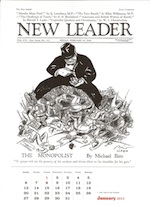
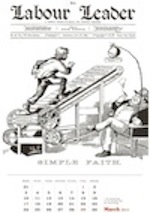
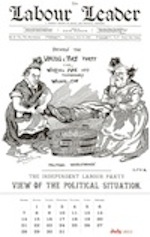
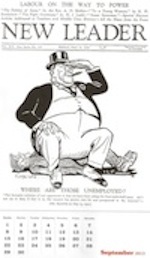
Iconic political cartoons from the 1890s and 1920s are featured in a new wall calendar published by the ILP to mark our 120th anniversary next year. ILP Calendar cover

Launched to celebrate the founding of the Independent Labour Party in Bradford in 1893, the A4 calendars are illustrated by biting socialist cartoons first published in Keir Hardie’s newspaper, Labour Leader, in the 1890s and its ILP successor, New Leader, in the 1920s. They are not only a poignant reminder of our past but retain significant political relevance today.
The founding conference of the ILP on 13 January brought together local ILPs which had already been established, particularly in the north of England, plus the Scottish Labour Party and many individuals eager to promote its cause. The ILP became Independent Labour Publications in 1975.
The ILP 1893-2013 wall calendars cost £9.00, including postage and packing, from Independent Labour Publications, PO Box 222, Leeds LS11 1DF. Cheques payable to ‘ILP Trust Ltd’.
To buy a calendar by PayPal, click here.
For more information email: info@independentlabour.org.ukILP Calendar Jan
—-
To read more about the ILP’s history visit our History section here.
To mark the anniversary, the ILP will also be publishing an updated version of The ILP: Past & Present in the new year while this website will feature a series of biographical articles on significant ILPers from Labour history.
More details of 120th anniversary publications and events will be published here in due course.
ILP Calendar FebILP Calendar MarILP Calendar JulILP Calendar Sep                   

Thursday, November 15, 2012

Clay Cross - 90 Continuous Years With Labour


It is a 90th Anniversary. Since 15 November 1922, Clay Cross has been represented in parliament by only Labour MPs. Since 1950, it has been part of the North East Derbyshire Constituency and the MPs (in turn) have been Henry White, Tom Swain, Ray Ellis, myself and currently Natascha Engel. Yet prior to the 1950 General Election, Clay Cross was part of the Constituency which bore its name. Below I give a synopsis of that Constituency's Labour Parliamentary History.

 The Clay Cross Parliamentary Constituency operated from 1918 until the time of the 1950 General Election. It covered much of what are currently the southern areas of both the North East Derbyshire and Bolsover Constituencies. In those days it was an area in which coal mining abounded.

Yet although the Constituency was dominated by the miners’ vote and the Derbyshire Miners' Association (DMA) was a powerful influence in the area, out of the six different Labour candidates it ran for parliament at various elections, only two of these were miners. The absence of miners as Labour candidates in parliamentary contests in 1922, 1923, 1924, 1929, 1931, 1933. 1935 and 1936 (when four different Labour candidates ran) showed an independence of mind amongst local miners from the pressures of the leadership of the DMA. This was aided by the influences of a socialist-inclined local Methodism and by left-wing activists in the Independent Labour Party (ILP) in areas such as Bolsover. The ILP, however, went on to disaffiliate from the Labour Party in 1932. A further factor leading to the period in which miners' were not run as candidates, is that Clay Cross became one of the safest Labour seats in the country. It, therefore, attracted the interest of leading figures at national level in the Labour Party.

The first election in the Clay Cross Constituency in 1918 followed a conventional pattern for an area dominated by the DMA. . Fred Hall, the Labour candidate was a leading official of the DMA, who eventually served for 29 years on the national executive committee of its parent body, the Miners' Federation of Great Britain. He was, however, the only Labour candidate for the Clay Cross Constituency who ever failed to win the seat. He lost by 1,221 to a Liberal who had Conservative backing. For the Conservatives and Liberals who had been the larger elements of the 1915-18 War-time Coalition, had joined into a deal aimed at not running candidates against each other. 

When Fred Hall dropped out of standing for the seat just prior to the 1922 General Election, Charlie Duncan was selected in his place. He had helped to found the Workers’ Union who had been involved in the birth of the Labour Party and represented unskilled workers. He had been the Labour MP for Barrow-in-Furness from 1906 to 1918 and had spells as both Whip and Secretary for the Parliamentary Labour Party. He won the elections in Clay Cross in 1922, 1923, 1924, 1929 and 1931. His final success revealed how Labour had built up the seat. The 1931 election was held following the collapse of the minority Labour Government in the middle of a major financial crisis, with Ramsay MacDonald its leader defecting to run a National Government. Labour’s position at the subsequent General Election collapsed from 288 to 52 seats, yet Labour held Clay Cross by almost 10,000 votes. A massive Labour majority in the adverse circumstances of the time. 

When Charlie Duncan died in 1933, Clay Cross adopted Arthur Henderson as their candidate. Known as “Uncle Arthur” he was a huge figure in the early history of the Labour Party. He was leader of the Labour Party from 1908 to 1910 (with another spell at the start of the First World War). He served as Labour’s first Cabinet Minister in the First World War Coalition Government from 1915 to 1917, resigning when his idea for an international conference on the war was voted down by the rest of the cabinet. He helped shape the pre-Blairite structure of the Labour Party as its General Secretary, a post he held from 1912 to 1935. He was Home Secretary in the first Minority Labour Government of 1924 and Foreign Secretary from 1929-31. When MacDonald defected Henderson took over as Labour's temporary leader until 1932, but gave up the position because he had by then lost his parliamentary seat. Clay Cross provided his avenue back into Labour’s parliamentary politics. In the by-election one of his opponents was Harry Pollitt the General Secretary of the Communist Party who lost his deposit with 10.8% of the votes to Henderson’s 69.3%. So there was a total left-wing vote of over 80%. Whilst he was MP for Clay Cross, Henderson went on to receive the Nobel Peace Prize and was held in high regard, it being claimed that “no-one ever sought his help in vain"*. He died in 1935.

At the subsequent General election, Clay Cross ran the 35 year old Alfred Holland who was a local Methodist. But within 10 months he was stricken with spinal meningitis and died shortly afterwards.

A by-election in 1936 led to the Clay Cross Labour Party running its fourth candidate in five years. George Ridley had been on the Executive of the Railway Clerk’s Association since 1909. He was seen as “becoming the Labour Party’s leading pamphleteer*”. In 1944 he also died whilst still an MP.

After 26 years, Clay Cross once more adopted a Derbyshire Miners’ Candidate in Harold Neal the area’s Vice President, who went on to become Secretary of the Miners’ group of MPs in parliament. There was a war-time pact amongst Churchill’s Coalition partners at the time, which covered the Labour Party. This amounted to a deal not to run candidates against coalition partners in by-elections. So only two independent candidates stood against Neal. One ran as a “Workers Anti-Fascist” and the other as an “Independent Progressive”. Neal got 76.3% of the votes. When the war ended, he improved his position by taking 82.1% of the votes in opposition to a Conservative.

When the boundaries were redrawn and the Clay Cross seat was absorbed into other areas, Harold Neal became the Labour MP for Bolsover. He had a period as Parliamentary Secretary to the Minister of Fuel and Power in 1951 and retired as MP in 1970 to be replaced by Dennis Skinner who was the Chair of NE Derbyshire Labour Party, President of the DMA and also an active member of the Clay Cross Labour Party.

A souvenir brochure published by the Clay Cross Divisional Labour Party in 1948 pointed out Labour’s dominance in the area, stating that there were “46 Local Government Seats (exclusive of Parish Councils) within the Constituency : of these 40 are held by Labour members. In addition, there are 16 Parish Councils : in the majority of cases we have 100 per cent representation”*. ( * = The two earlier quotations are also taken from this souvenir brochure.)

Those were the days.

Friday, October 26, 2012

From Today's Guardian : Letter To The Editor


Fallout from the Scottish referendum


One of the strongest arguments for giving the vote to 16-year-olds, as proposed in Scotland (Editorial, 22 October), is that it is an essential step towards tackling voter under-registration. The Electoral Commission has reported that at least 6 million people are missing from electoral registers. Yet now we see that the under-registration figure is likely to be larger than this, as census details have just been revealed which show that 1.57 million people in England and Wales have second addresses and this will entitle many of them to double registration. If, say, 1 million throughout the UK have done this, that means that under-registration is then over the 7 million mark.With votes at 16, the names of "attainers" would be included on registers when they were 15, showing the dates of their coming birthdays and their then entitlement to vote. If registration for these first-time voters took place via their schools, an initial registration of almost 100% could be achieved. A proactive registration system could then be put in place to ensure that most of those who initially registered did not later in life slip through the net.

As under-registration is high among the 18-25 age group, the poor, the rootless and ethnic minorities, this leads to a situation where the boundaries of parliamentary constituencies are seriously distorted. A system of initial registration via schools, with an associated and imaginative educational programme, could start to correct this imbalance and develop a commitment among young people to use and improve the democratic process. Or are we going to leave it all to Alex Salmond?

Harry Barnes
Dronfield, Derbyshire

Monday, October 1, 2012

The Clay Cross Rent Rebellion


It is the 40th Anniversary of the Clay Cross Rent Rebellion. So what was it all about?

In 1970, the Conservatives had a surprise electoral victory. Ted Heath replaced Harold Wilson as Prime Minister and became known as Selsdon Man, because he adopted a set of free market and anti-working class policies which were in line with what would later be called Thatcherism. The strong reactions against his approach later led him to alter his basic stance via a set of "U" turns, for which Thatcher was later to deride him.

In the year in which the Heath Government was established, council house building was still widespread and only fell marginally short of the total number of houses built under private enterprise for both owner occupation and renting. Furthermore, many Labour Councillors themselves lived in Council houses and understood the needs and interests of communities they were part of.  The Heath Government wished to switch the housing pattern for working class people away from their heavy dependence on council housing.

In pursuing their interests, the Conservatives produced a White Paper entitled "Fair Deal for Housing" which prefigured their Housing Finance Act which received the Royal Assent on 27 July, 1972. Well before the measure became law, the Government's intentions were well understood and were creating considerable concern amongst council tenants and their Labour Councillors. Government subsidies to reduce rents were to end. Councils were to be stopped from supporting council rents from the rates. Then (as a start) most Council Rents would have to be raised by £1 per week in October 1972, which is an amount approaching £11 in today's prices. If a Council failed to act in conformity with these provisions (a) any subsidies for Council House Building would be ended and/or (b) a Housing Commissioner would be sent in to operate the Act. 

On 10th June 1972, 223 delegates from 87 ruling Labour Groups met in Sheffield and carried a resolution by 74 votes to 1 (with 5 abstentions) demanding that "the labour movement shall not take steps which may lead to the implementation of the Bill."

Clay Cross in North Derbyshire had a population of 10,000 and had 1,400 council tenancies catering for over half of its population. Its 11 Councillors were all Labour. On 4th September 1972 it unanimously adopted the following motion - "That this Council will not operate any of the provisions contained in the Housing Finance Act 1972, and the Electorate shall be informed of the decision together with the reasons for coming to this decision and that the officers of the council be instructed not to make any preparations for implementation of any of the provisions of the Act nor to act on behalf of the Conservative Government as a Commissioner".

Initially a total of 46 Councils failed to operate in line with the legislation, whilst 80 Tenants Association were organised to hinder its operation. In the Chesterfield Rural District Area which surrounded Clay Cross their Tenant's Association ran a campaign for the non-payment of the £1 increase which its Labour Council had "reluctantly" introduced. In Dronfield, situated at the Northern End of the Chesterfield Rural District, its Urban District Council was Conservative-controlled and it had jumped the gun with a 50p increase in the April. Its Tenants and Residents Association, therefore, started out with a fortnight's rent and rates strike exactly 40 years ago today.  Dronfield had 1,000 Council Tenancies.

But much larger and immediately to the north is Sheffield where a Coordinating Committee for Tenants, Residents and Community Associations had been established in 1971. Sheffield having 76,000 Council Tenancies. Dispite this bodies' pressures, the Sheffield Council implemented the Act by 53 votes to 42, carrying out a later increase by 45-40. The second increase rested on the votes of 12 Sheffield Aldermen, but at least a non-eviction pledge was given for those withholding the increases.

Powerful pressures were, however, placed upon all the non-implementing Councillors and upon the tenants and residents who withheld rent or rates monies. By January 1973, 32 of the rebel Labour Councils gave up the struggle. 12 held out until later in the year. That left only Bedwes and Machen in Monmouthshire and Clay Cross in Derbyshire as non-implementing Councils. They both had a Housing Commissioner sent to their authorities to enforce the legislation. Bedwes and Machen did not block his work, so they were then out of the struggle. Clay Cross, however, blocked the work of the Commissioner and continued the fight.

Acton was taken against them by the District Auditor who claimed that they were responsible for a shortfall of £69,000 in their revenue account and could be bankrupted and thus debarred from office.  Eventually this position was upheld by the a High Court Decision by Lord Denning on 30 July 1973.

Fresh elections were then held in Clay Cross and Labour took 10 of the 11 seats with a 85% turnout. Local Government Reform meant the Clay Cross Urban District Council would be absorbed into a larger authority a month after the election and those elected would then become Parish Councillors, without Council Housing responsibilities. But for its remaining month as a District Council, the Labour Councillors refused to implement the Housing legislation. This led to the District Auditor surcharging them "jointly and severely" so that their liabilities fell over the £2,000 mark which would lead to their debarment. To save fresh bankruptcies among the second team the local Constituency Labour Party ran a defence fund, which paid off their debts. This fund, however, did not cover the much wider surcharges levelled against the original team of Clay Cross Councillors.

The Clay Cross situation was a matter of continuous dispute within the Labour Party from 1972 until 1978.  In 1972, Conference passed a resolution supporting the local campaigns of tenants, trades councils and Labour Parties "to spearhead the campaign against the Act". But it rejected a move for the retrospective clearing of "any councillors who suffer any penalty through their actions." Yet in 1973 it passed resolutions supporting "opposition to continuing rent increases" and backing Clay Cross. Furthermore, David Skinner one of the non-implementing Clay Cross Councillors stood for the Constituency Section of the National Executive Committee of the Labour Party and obtained 144,000 votes. This section invariably elected Labour MPs and, although David, wasn't elected it was a telling result which showed strong support in the Labour Party for the Clay Cross struggle. The Clay Cross issue was pursued unsuccessfully at the 1974, 1975 and 1976 Party Conferences. But then in 1977 Conference overwhelmingly carried a resolution stating "This Conference deplores the continuing disqualification from public office of the 21 Clay Cross Labour Party members and demands that the Government introduce a Bill to remove the disqualification forthwith". David Skinner went back to the rostrum the following year complaining that the NEC had not even pursued the matter with the Labour Government.

Whilst the struggle against the Housing Finance Act did not succeed in its objectives, it was part of wider campaigning which led to Heath dropping his Selsdon Man approach. When Labour returned to office there was then a recovery in Council House building, until it was successfully undermined by Thatcher's tactics. The persistence with which the Clay Cross issue was pursued at Conference (especially on the initiative of its Constituency Labour Party) also shows the significance of the democratic arrangements that were then open to the rank and file of the Labour Party, which have since been removed. 

Yesterday evening the Dronfield Labour Party Discussion Group were fortunate to discuss these matters, when David Skinner addressed it on the "40th Anniversary of the Clay Cross Rent Strike". What appears above is, however, my own contribution and not a report of David's fine talk. My main sources have been Leslie Skfair's article "The Struggle Against The Housing Finance Act" in 'Socialist Regsiter 1975' and the Annual Reports of the Labour Party for the period. Anyone spotting errors, should use the comment box below.

Thursday, September 20, 2012

"The Wider Case For Constitutional Reform" by Ken Curran


The cause of our present economic crisis has its roots in a number of areas. Whilst I subscribe to the opinion that the main factor is the very nature of modern capitalism, there is another key matter to consider. If we had a very different form of parliamentary system where the power of the executive was both defused and diminished, it is possible that the current crisis would have been averted. We  need far more democratic forms of government. In what follows, I will argue that a Written Constitution and provisions for devolved Government in deprived areas such as the North would assist us in pursuing the type of political awakening I am seeking. These are not panaceas by themselves, but they offer a better framework for a democratic future than anything in today's sterile arrangements. But they must be pursued not just as constitutional tinkering, but as clear avenues for achieving economic and social justice.   

In 2007 a number of economic commentators began expressing concerns over the behavior of the Sub Prime Market in America. A leading British economics writer, Larry Elliott of the Guardian (along with Dan Atkinson) had a book published called "Fantasy Island". He was referring to the United Kingdom. The front cover had Tony Blair in a deck chair on a tropical island enjoying a fancy drink and sunning himself, whilst behind him there is a huge storm and everything is collapsing.  Whether Tony and Gordon Brown (who is clinging onto a palm tree as a tsunami is about to engulf the fantasy island) were deliberately misleading parliament and the country over the true state of the economy is history and may never be fully established. Anyone who heard the infamous Mansion House speech of Chancellor Brown could be in no doubt that they were listening to a man (who represents one of the poorest constituencies in Scotland) extolling the virtues of the City of London. Gordon Brown had fallen in love with Capitalism and its London manipulators. Blair and Brown were apparently oblivious of the pending storm. Within three weeks of Gordon's speech, the alarm bells were ringing over the collapse of Fannie Mae on the US West Coast, exactly where Larry Elliot had forecast it would. Which begs the question. How can a newspaper's economist forecast what was going wrong and accurately state where the economic collapse would occur, when both the Prime Minister and the Chancellor were oblivious of the pending doom?

Northern Rock and the Icelandic Government were the next to fall. By then, Gordon Brown realised that something was wrong. Larry Elliott was not the only one who suspected that all was not well with the economy. I know a good number of ordinary people who couldn't make sense of our boom in house prices during the early years of this century. Little did we realise that this was due to illegal manipulation of the market to boost the profits of the banks. Which begs a further question. How was it that ordinary people questioning the ever rising value of houses, never led on to politicians searching out the reason for this phenomena? Of course, it wasn't a phenomena at all. It was a big scam! Even as all was falling around Gordon Brown and he was struggling to manage the chaos across the world as the British economy headed for the buffers, both Cameron and Osborne (the Laurel and Hardy of British politics) were also oblivious to what was happening. Their remedy was to continue to call for further relaxations of controls upon businesses, plus reductions in public spending.

Over the past thirty years, the percentage of people entitled to vote has been in decline. The underlying truth is that people feel unrepresented by their very representatives. There is little at stake for them in the representative process.  The influence of Capital on Government is weakening democracy. Money versus the People. Politicians seduced by Business. The City of London and its Finance is the cancer at the heart of British Democracy. Like an ancient army raping everything of value, Capitalism marches on consuming all before it and laying to waste where it has been. It is imperative that we reform our political system to ensure that we protect humanity from the rapacious and greedy system which currently is destroying everything which our parents and grandparents strove for.  Currently the new technology is being used to enslave and indoctrinate the people in order to create a malleable and docile people under the control of the Corporate State. Fascism is not dead!

We must revive the spirit of the founders of Chartism. If not for our sake, but for that of our children and grandchildren.

We still try to govern the United Kingdom in the 21st Century using the protocols and rules of a bye-gone age. I am sure that the Government's constitutional lawyers must constantly struggle with the many varied interpretations which exist of Magna Carta, trying as best they can to link the relevance of modern day issues with a document written in order to resolve conflicts of interests between the King and Norman Barons in the 13th Century. It was not written with the interests of the wider population in mind. Bearing in mind the passage of time since the Great Charter was written, the case for Constitutional Reform is self evident. Britain must be the only country in the world without a written constitution. Most countries in the West have constitutions written in a single and accessible document, which clearly define rights and responsibilities for the governed and their governments. The Magna Carta makes no mention of either women or children, for like the peasants and yeomen of the day, they were held to be of no account. The references in Magna Carta to Peers originally referred to Barons, yet by a clever devise of political and legal expedience this is now taken to mean everyone. When one considers the huge changes taking place across the world, these contrast with the semi feudal rules and customs which still influence our decisions. Our arrangements are quaint, out-of-date, or in modern parlance "not fit for purpose". When the Magna Carta was originally signed and sealed, all rights to award titles, awards and appointments rested with the Crown. Over time all of this patronage has passed to the Prime Minister. This has put a huge amount of power into the hands of whoever holds this office. We should remember that whilst the electorate participate in electing individual Members of Parliament, they are never directly involved in choosing the Government or the Prime Minister. In normal circumstances, whoever is King or Queen uses historical protocol to invite the Leader of the Party with the largest number of House of Commons members, to form a Government. The amount of power at the centre of our political system is unhealthy. We need to bear in mind that much of our system is not controlled by laws which are on the Statute Book, but by age old practices, with a good deal of nods and winks.

This is hardly a way for a democracy to work in the here and now. To my own knowledge and experience, we can today see our way of life changing more rapidly then any time over the past 70 years. There are a number of issues thrown up by the modern life-style of living in the fast lane, which we do not have the ability to find solutions to. Of these, the impact of new technology upon employment is not yet fully understood: yet this is coupled to the global market with its swift movement of both money and decisions. It is imperative that we create a democracy that is both strong and able to respond to the strains of the system. On top of the problems created by new technology, we have to find answers as to how we cope with climate change. After the summer we have just experienced, most people should be convinced that climate change is actually with us. Governments have paid insufficient notice to scientists, whilst listening instead to the lobbyists from big business.

Even as I write politicians are still beating the drum for competition and more competition, when what is needed is co-operation. In the present circumstances it is only by co-operation that we shall survive. We face an uncertain future, with crops destroyed by storms, forest fires and floods. These take place in the context of market forces creating unstable economies and declining resources. For the first time in 60 years we are witnessing a decline in our living standards.

Yet our needs to tackle both climate change and impacts of our private enterprise system, are also key constitutional issues. This is because our parliamentary system has a cosy relationship with big business and its comprehensive lobbying system, which acts as a barrier to the essential changes which are needed for the general well-being. Examples of corporate connivance abound, such as the attempts governments have taken over several years to get a simple system into our shops and supermarkets whereby customers can readily distinguish between healthy and unhealthy products. I defy anyone to tell at a glance whether what they have purchased is actually healthy or not.  This is just one example of the business community influence in blocking governmental objectives, on top of which large numbers of MPs have both direct and indirect links with business. For example, these are never worried about matters such as the amount of salt contained in a packet of crisps.

I was a schoolboy during the Second World War. Squadron after squadron of Luftwaffe Bombers would drop thousands of incendiary bombs, not only on our docks and factories, but our residential estates were targeted. We suffered power cuts, severed water mains, rationing and frequent food shortages. We survived only by co-operation, not competition. Out of this approach an improved life was built after the Second World War. But what was achieved is now being destroyed. We will move into a permanent state of chaos, unless  we learn to throw off the political lethargy that currently prevails at almost every level of society. I honestly can't see the needed leadership grit and determination coming from our current political parties. They have been seduced and corrupted by Capital, which has robbed them of their freedom of thought and action.

It is my experience of over 60 years of political activity, and the history I have lived through, which has led me to conclude that it is only by a complete cleansing of our political and business institutions that we can avert the worst conditions which confront us all. The reform of our current political system alone cannot address the huge chasm in our society. All of the various regions of the United Kingdom suffer from the malaise which is eating away at what is left. There is still a good deal to be done in the UK by lots of the people of these islands. Increasingly people are astonished by our sports athletes and their achievements, whose behaviour is quite at odds with our Bankers and Politicians who generally lack a commitment to anything unless it involves loads of money.

THE CAMPAIGN FOR NORTHERN RENEWAL

The Hannah Mitchell Foundation aims to achieve a Northern Government. This important aim will not, however, be achieved just on the basis of a campaign for constitutional reform. For a public debate limited to the whys and wherefores of constitutional reform will fail to generate enough enthusiasm to maintain public interest. The campaign needs two strands. One to promote the technical arguments for constitutional reform. The other to put the economic, social and environmental cases.

Those of us who have lived through and endured the pain of the industrial decline of the North of England have been quietly seething to see the way our manufacturing base has been destroyed. We have stood witness to both men and women workers being thrown on the scrap heap. At the age of 40,  people being told that they were getting too old for re-employment. The North still suffers from its loss of its Textile Industry, Ship Building and Repairing, Fishing Industry, Heavy Engineering, Steel Manufacturing, and its Coal Mines. They have been replaced by what a famous veteran of Labour Politics, Denis Healey, once disparagingly described as a "Candy Floss Economy". For too long we in the North have tolerated being treat as second class citizens and our loyalty to Labour has been abused. It is time for the North to get angry and speak up for itself. Our Parliamentary Representatives have been timid and afraid to rebel to make demands on our behalf. We need to create a Charter for the North. Part One dealing with the case for devolved Government, promoting new ideas and suitable alternatives. Part Two could be in the form of a Manifesto spelling out what we believe could be achieved under a suitable Government of the North. It is Part Two which is most likely to enthuse and excite people with its vision and possibilities.It is when people are enthused by the full picture that they will realise the possibilities of the full venture. At that point people shall be part of the wider movement for social, economic and political change, pointing a clear way out of our dark and uncertain future. We can give people a sense of hope and rid ourselves of the political lethargy which currently exists. We must be clear in our message - there is a better way.

KEN CURRAN



Thursday, September 6, 2012

Ed's Clause 4 Moment


 In effect it now reads -

"To secure for the workers by hand or by brain the full fruits of their industry and the most equitable predistribution that may be possible upon the basis of the operation of responsible capitalism."

Below is the relevant extract from Ed Miliband's speech made (appropriately) at the Stock Exchange where he called for "predistribution" under "responsible capitalism" . The full speech can be found here.

"Of course, redistribution will always remain necessary.  But we've learned that it is not sufficient. And fiscal circumstances will make it harder not easier.  The new agenda is that we need to care about the model of the economy we have and the distribution of income it creates.We need to care about predistribution as well as redistribution.

Predistribution is about saying: 'We cannot allow ourselves to be stuck with permanently being a low-wage economy'. It is neither just, nor does it enable us to pay our way in the world. Our aim must be to transform our economy so it is a much higher skill, higher wage economy. Think about somebody working in a call centre, a supermarket, or in an old peoples' home. Redistribution offers a top-up to their wages. Predistribution seeks to offer them more: Higher skills.  With higher wages. An economy that works for working people. Centre-left governments of the past tried to make work pay better by spending more on transfer payments. Centre-left governments of the future will have to also make work pay better by making work itself pay. That is how we are going to build growth based not just on credit, but on real demand. And that is how we are going to help the squeezed middle of this country and, build a better economy when there is less money around."

So what are Eds the first steps in his journey towards predistribution under responsible capitalism?

He went on to say "to tackle the challenge of predistribution...we have made proposals on changing the way the banking system works, and promoted a British Investment Bank...Sir George Cox, formerly Director General of the Institute of Directors, is leading our review on short-termism...We need proper competition in all sectors of the economy so that consumers get a fair deal. That means not allowing any cosy cartels to develop in any sector, from energy to our train network...We also need...all Government departments working together, including through procurement, to support British business...We need a skills system...And we plan to build that new agenda with schools, young people, businesses and trade unions working together to fashion our new vocational training system...We need a special welfare state that encourages people to work, and rewards those who do...the move towards responsible capitalism is actually being led by many business people...A responsible capitalism is a resilient capitalism".

Ed's dream seems to be a belief in the establishment of a system of "perfect competition", whose early advocates claimed would work for the benefit of all - whether they earned their living from their land, their labour or their capital. But it is a long time since this idea was even seen as a dream. We have long since moved into a world dominated by forms of monopoly capitalism, whose interests have themselves come to dominate political activity. An effective move to predistribtion would require measures such as a ceiling for earnings and wealth holdings, as well as improved minimum wages and benefit levels. But that would be called redistribution, rather than predistribution.   

Wednesday, August 15, 2012

Living In The Shadow Of The State : By Ken Curran


This is not about some central European State during the days of the Warsaw Pact and the Iron Curtain. Although the title may suggest that possibility. It is about the United Kingdom, its form of Government and its relationship with Local Government.

I have just re-read the Sheffield Labour Group's 2012 Manifesto. Its aims were modest and, I believe, honest when published. Almost six months later, the document measured against events has begun to show just how difficult it has become for Local Government to make any promises prior to an election. This is particularly the case in England.  Local Authorities in both Scotland and Wales under their own devolved Governments are more fortunate than their neighbours, in no longer having to deal with London. They have benefited by having their own Civil Servants who live either in Wales or Scotland, as do all those Members of the Welsh and Scottish Assemblies who form their administrations.

Since 1979, the scope of Local Government has changed almost out of all recognition. So has the way in which Councils make their decisions. The old Committee Systems have been scrapped, changing the roles of Councillors who are now unable to influence decision-making or to initiate new policy. The Cabinet System which is now used is where the main strategic policy decisions are first promoted and debated. Members of the public can attend Cabinet Meetings. There are also Interest Panels which the Council Leader attend, along with Chief Officers and key Councillors. From a political standpoint, the most important Panel is the one which includes Industrial and Commercial interests, which in Sheffield extends to the Universities and the NHS. Whilst these outside bodies can be involved in the considerations about Council Policies and the performance of Council Services, they can't dictate policy to the elected Council. They can, however, influence political decision-making in a way that is not available to the general public. So whilst the Panels widen debate, they also give undue influence to vested interests in the City. The changes over the years has forced Local Councils to behave like Private Businesses. This new system actually stifles debate rather than enhancing it. The nature of local politics now revolves around who runs services. Increasingly in Sheffield this is not the Council.

In the late 1970's Nicholas Ridley, who was the Local Government Minister in Margaret Thatcher's Government, advocated that Local Councillors should meet once a year to select who would run the Council Services for the next year. I hate to consider somebody like Nicholas Ridley to have been a visionary. He has gone to where he can no longer threaten people, but all those people who live in daily fear of their jobs have the likes of Nicholas Ridley to thank for their sleepless nights. We have almost arrived at where Ridley and Thatcher wanted Local Councils to be. The journey has been aided and abetted by New Labour masquerading as progressives. We now know today that we were actually deceived by these people. We have not improved the level of Local Government debate nor enhanced democratic decision making.  Conversely we are putting millions of pounds sterling into the private sector, so that profits can be made at public expense. Local people are losing out all the time. When services are either outsourced or formally contracted out, it always involves losses in both employment and the levels of earnings for those staff who are retained. Even those workers protected by TUPE* transfer agreements are only covered for a temporary period. Councils hide the full implications of privatisation. Yet however Councils try to camouflage their actions, the adverse consequences of their actions are always borne by those living at subsistence levels.

Labour Councils, rather than actually representing the views and aspirations of local people, become agents of the Westminster Government. Local Democracy is increasingly undermined by the state. No Labour Councillor joins the local council to sack local people, yet in effect up and down the country they find themselves increasingly doing the dirty work for the Westminster Government. The reason so many people don't vote is that they feel unrepresented under the present system. Local Councillors are spending a good deal of their time carrying out the instructions of Government Ministers and not representing those who voted for them. The people of Sheffield, Chesterfield and Rotherham played no part in creating the current economic crisis, yet they are paying a very heavy price for it. The case for radical constitutional reform is long overdue. Why can we not have our own Northern Parliament with the same sort of rights as the Welsh and Scottish people? I am sure that we are quite as capable of governing the North of England more honestly and sincerely than Whitehall has ever done.

KEN CURRAN.        

* =   TUPE stands for Transfer of Undertakings (Protection of Employment) Regulations. These as supposed to protect people when their employer changes, such as when a company is taken over or a public service is contracted out.